24/7 Emergency Service Open 7 days · 7am–8pm Serving Parma, OH & nearby
(216) 359-8164
Parma, OH

Why Your Garage Door Sensors Keep Drifting Out of Line

Parma homes built mostly in the 1960s and 70s have concrete slabs and framing that shift with frost, which knocks safety sensors out of alignment every winter.

Why Your Garage Door Sensors Keep Drifting Out of Line

The Situation

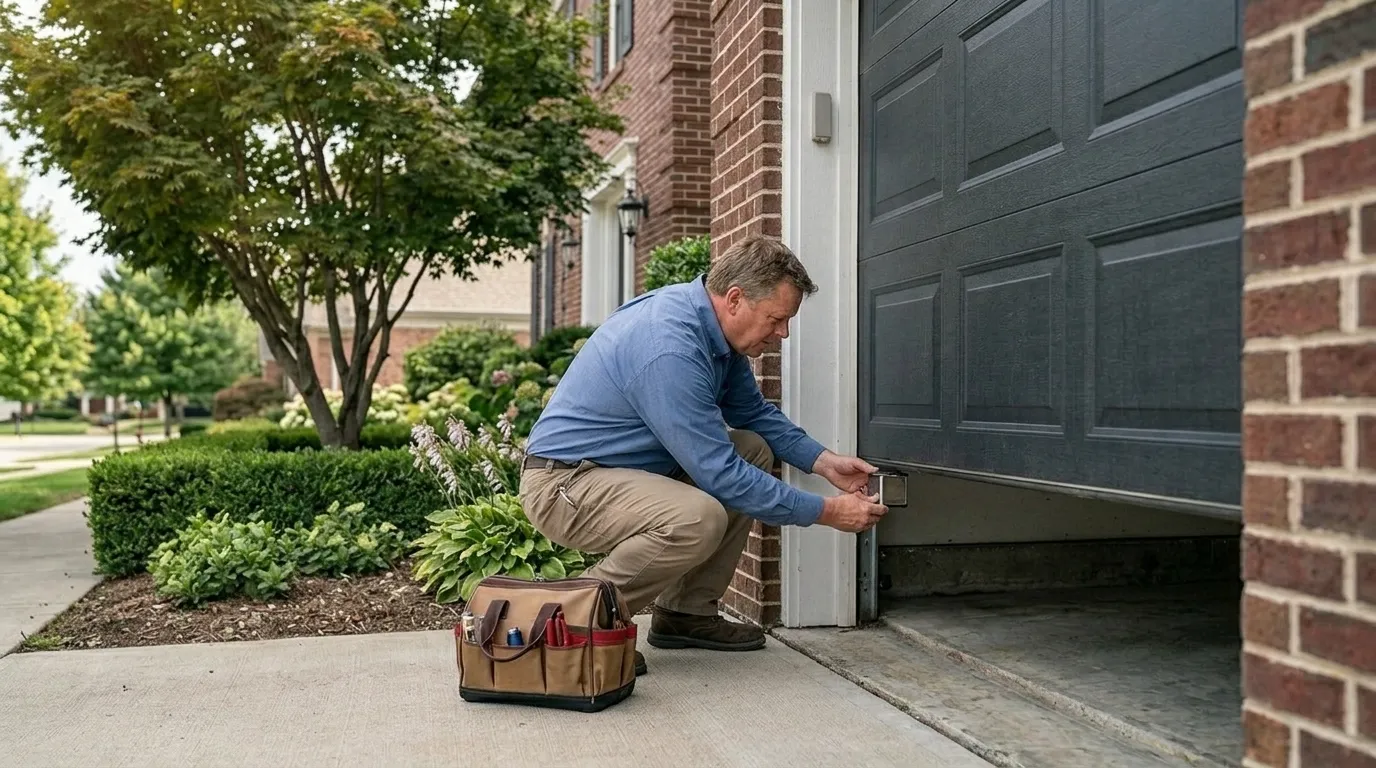
Most garages in Parma went up between 1938 and 2004, with the bulk of that stock dating to the 1960s and 70s. Those slabs were poured before anyone worried much about sensor brackets holding a fixed line of sight for forty or fifty years. The photo-eye sensors mounted low on each track rail depend on staying pointed at each other within a fraction of an inch. In a newer build on fresh concrete, that's rarely a problem. In a garage with a slab that's had five decades of freeze-thaw cycles under it, the bracket that held true in October can be a half-inch off by February, and that's enough to make the door refuse to close or reverse halfway down for no reason anyone in the house can see.

We get called on this constantly here, and it's almost never a bad sensor. It's a bracket that moved because the wall or slab it's screwed to moved first. On a house from the 1966 era - the rough median for this area - that movement has been happening slowly for close to sixty years, and it doesn't stop just because the door still opens fine most days.

The Seasonal Bit

Parma sits in a cold-severe climate band, and that matters more for sensors than for almost any other garage part. The alignment problem isn't the cold itself - it's the concrete slab expanding and contracting under it as ground temperatures swing hard from summer to winter. A slab that heaves even slightly on one side changes the angle of whatever is bolted to it, including the sensor bracket a few inches off the floor.

This is why so many service calls here cluster in the weeks after the first real cold snap and again in early spring thaw. The sensors were aligned fine in September. By December, the slab has shifted enough that the beam that used to clear the door track by an inch now clips it, or misses the receiving eye by just enough to trip a fault. It's not a defect in the sensor. It's the building settling into winter the way it does every year in a climate this severe, and the bracket just can't keep up without a recheck.

What Most People Get Wrong

The instinct is to assume a sensor that's throwing a fault light is broken and needs replacing. Most of the time in this area, replacing it does nothing, because the sensor itself is fine - it's aimed wrong. Swapping in a new unit at the same angle just gives you a new sensor with the same old problem.

The other mistake, common in houses from the 1960s-70s wave that makes up most of Parma's stock, is assuming the door opener's settings are the issue and adjusting the force or travel limits instead of checking the physical alignment. That can mask a misaligned sensor for a while, right up until it doesn't, usually on a cold morning when someone's already late. If your house is from that era and the door has started acting up only in the last year or two, the alignment is the first thing worth checking, not the last.

We won't tell you to replace a sensor pair that just needs its brackets reseated and re-aimed - that's a five-minute fix, not a parts order.

What Local Conditions Do

In a slab and framing stock this old, sitting through winters this cold, sensor brackets loosen at the screw points slowly rather than all at once. Each freeze-thaw cycle works the fasteners a little looser and shifts the slab a little more, so the sensors that were dead-on in June can be noticeably off by the time the first hard freeze hits. This is a slow drift, not a sudden failure, which is why most homeowners don't catch it until the door starts refusing to close.

If your garage is on the older end of Parma's 1938-2004 range, or anywhere near that 1966 median, it's worth having the brackets checked and re-torqued once a year, ideally before the first freeze. That single check catches most of the false-fault calls we see before they turn into a no-close situation on a night you actually need the door to shut.
How it works

From “it’s stuck” to “it’s fixed”

Tell us what’s wrong - Parma garage door service

Tell us what’s wrong

Describe the symptom - won’t open, loud bang, opener runs but the door won’t move.

On-site diagnosis - Parma garage door service

On-site diagnosis

A technician tests the door under power and by hand and finds what actually failed.

Clear, up-front plan - Parma garage door service

Clear, up-front plan

You get the fix that’s needed and what drives the cost - before any work starts.

Repaired & tested - Parma garage door service

Repaired & tested

The repair is done, the door is set true and tested, and the work area left clean.

Serving Parma, OH - tell us what your door’s doing and we’ll take it from there.

70areas covered
How we work

What to expect

Diagnosis firstEvery visit starts by finding what actually failed - not a pre-written parts list.
The right part for the doorSprings and openers matched to the door’s weight and age, so the fix holds up.
Straight answersWhen a repair makes more sense than a replacement - or the reverse - you hear it plainly.
Clean, careful workTension released safely, hardware set true, the door tested under power before we leave.
Questions

Frequently asked

Straight answers about garage door repair in Parma. Still unsure? Ask us directly.

Why does my garage door sensor light blink but the door still won't close?

That blinking light usually means the two sensors can't see each other cleanly, not that one is broken. In Parma's older slab construction, the brackets holding those sensors shift slightly as the ground moves through winter, throwing the beam off by enough to trip a fault even though both units still work.

Does cold weather actually affect garage door sensors directly?

Not the electronics themselves - it's the slab and framing moving under the brackets as temperatures swing through a cold-severe winter like Parma's. That movement changes the angle of the sensor eyes, which is what causes the fault, not the cold hitting the sensor directly.

How often should sensor alignment be checked in a house like mine?

For homes built in the 1960s-70s wave common across this area, once a year before the first hard freeze is a reasonable check. Slabs from that era have had decades of freeze-thaw movement, and a quick bracket check catches most drift before it causes a no-close call.

Can I fix sensor drift myself or does it need a service call?

Loosening the wing nuts and re-aiming the brackets by eye is something many homeowners handle themselves. If the bracket itself has pulled away from cracked or shifted concrete, which we see in some of the older Parma-area slabs, that's a repair worth having looked at in person.

Ready to get your garage door sorted?

Tell us what it’s doing and where you are in Parma - we’ll take it from there.

4Services offered
70Areas covered
Diagnosisfirst, then the fix
Request a QuoteCall