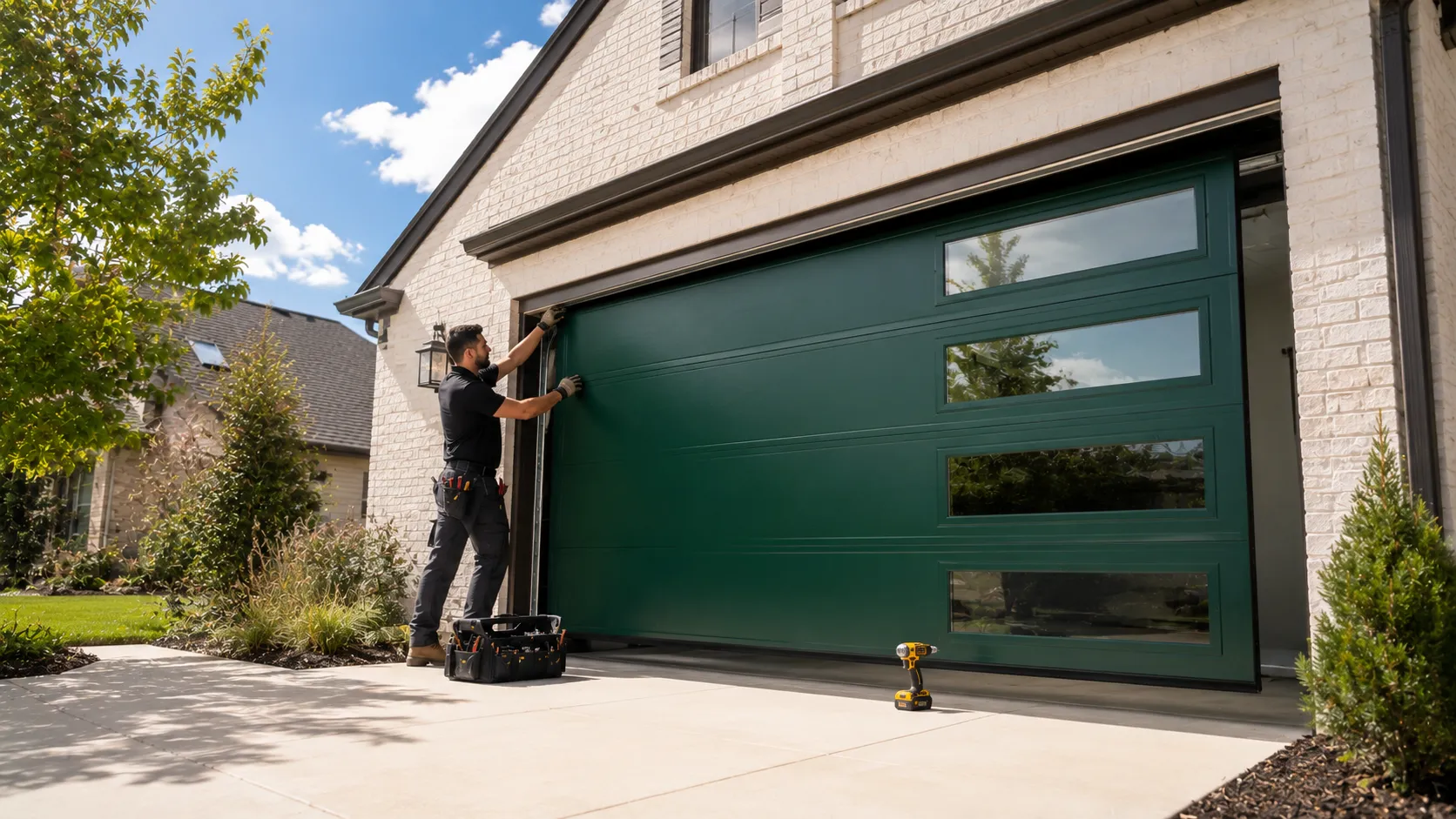
What the Repair Takes
Broadview Heights is a different animal from a lot of the neighborhoods we cover. The median house here went up around 1984, which means most garages were built with an opener already bolted to the ceiling joist, not added on later like they were in older streetcar suburbs. That opener is either the original unit, now forty years into a job it was built to do for maybe fifteen, or it's a replacement from the 90s or early 2000s that's now on its second or third decade.
Either way, the failure pattern is predictable. Chain-drive units from that era wear their sprockets and stretch their chains long before the motor itself quits. Circuit boards from the late 80s and 90s use capacitors that dry out and stop holding a charge, which shows up as an opener that hums but won't lift, or one that runs the light and does nothing else. We check the board, the capacitor, the drive gear, and the limit switches before we touch the motor, because on a unit this old the motor is rarely the actual problem.
We carry common logic boards and drive gears on the truck. Anything obsolete to the point that the manufacturer no longer stocks it, we'll tell you straight rather than promise a part that isn't coming.
Why It Happens Here
Cleveland-area winters run cold and hard, and that matters more to an opener than most owners think. Cold makes grease in a drive gear stiffen up, which puts extra load on a motor that's already thirty or forty years old. It also makes plastic gears - the kind used in most chain and belt drives from the 80s and 90s to keep noise down - brittle enough to crack a tooth on a hard start.
Broadview Heights' housing stock, built mostly in that same mid-80s window, means a lot of these openers are hitting that failure point around the same time, on the same kind of hardware. We see it as a cluster: one cold snap, several calls from the same era of house, the same worn sprocket or the same dead capacitor.
The other thing that shows up in a newer-built suburb like this is a well-maintained garage that still gets an old opener pushed past its reasonable life, simply because nothing else about the door needed attention. An owner replaces weatherstripping or a spring and never looks at the motor overhead until it stops working outright.
Time on the Job
Most opener repairs on a house this age take under an hour once we've diagnosed the fault - a capacitor swap, a gear replacement, a sensor realignment. What takes longer is sourcing parts for a board that the manufacturer discontinued years back. If that's the case, we'll say so on the spot rather than string out a repair that isn't coming together.
Here's the honest limitation: on an opener from the 80s or early 90s, there's a point where replacing the unit outright costs less than chasing down obsolete parts for a motor that's going to fail again in a year anyway. We'll tell you when we hit that point instead of billing you for a patch job. With 8,598 households in Broadview Heights and a median household income of $99,431 - a bit above the $95,313 median across the wider area we cover - most owners here choose the new opener when we lay out the comparison, rather than keep feeding parts into an old one.